Why Lightweight Planters are Changing the Way We Garden
There was a time when weight in a planter was taken as a proxy for quality. Terracotta, cast concrete, reconstituted stone; the assumption was that a pot worth keeping was a pot you could barely lift. That logic made sense when gardens were static, ground-level and permanent. It makes considerably less sense now.
The way we use outdoor space has shifted. Rooftop terraces, elevated decks, apartment balconies, modular courtyards that reconfigure between projects; these are the outdoor spaces being designed and specified today. And they come with structural load limits, strata bylaws and the practical reality that no one wants to hire a crane to move a planter in winter.
Lightweight planters aren't a compromise on that older model. They're a response to how outdoor space actually works now.
The structural argument
For architects and landscape designers, planter weight isn't an aesthetic preference; it's a specification parameter. An elevated deck or podium garden has a calculated load capacity. Exceed it and you have a problem. Work within it thoughtfully and you have options.
A high-quality lightweight planter, properly engineered from UV-stable, frost-resistant materials, can weigh as little as a tenth of its concrete equivalent while holding the same volume of soil and plant material. That difference in dead load translates directly into design freedom: more planters, larger specimens, groupings that would be structurally impossible with traditional materials.
It's a straightforward equation that's still underappreciated in how outdoor spaces get specified.

The practical argument
Beyond structural load, lightweight planters solve a problem that anyone who has seriously gardened will recognise: plants need to move.
Seasonal repositioning to follow light. Moving tender specimens undercover before frost. Reconfiguring a terrace for an event and then reconfiguring it back. These are normal parts of maintaining a considered outdoor space, and they become genuinely possible when a planter can be moved, or repositioned without equipment.
There's also the matter of soil health. The ability to lift, rotate and periodically refresh plantings without excavation keeps root systems in better condition and makes replanting, when a species has run its course or a brief change, a manageable task rather than a project.
What to look for in a lightweight planter
Not all lightweight planters are the same, and the category has attracted its share of products that prioritise lightness over everything else. A planter that fades in its first summer, cracks under frost or loses structural integrity under the weight of a mature plant is not a specification worth making.
The markers worth looking for are material stability over time; UV resistance that holds colour and finish across seasons, frost tolerance that doesn't require retreating indoors each winter, and wall thickness that maintains its form under load. Drainage geometry matters too: a lightweight planter sitting in waterlogged soil fails faster than a heavy one, so the drainage solution needs to be considered rather than incidental.
Form is worth taking seriously as well. The best lightweight planters earn their place in a space through proportion and resolved design, not despite being lightweight. Weight is a material property, not a design quality.

The low bowl as a case in point
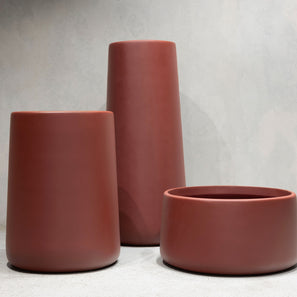
The wide, shallow profile of a low bowl planter is one that works particularly well in lightweight form. The geometry distributes load across a larger footprint, reads as grounded and horizontal in a composition, and suits the kinds of planting, mass ground covers, architectural grasses, low sculptural specimens, that define a space rather than decorate it.
Grouped at varying heights, a series of low bowls creates horizontal rhythm across a terrace or courtyard. Used individually as a centrepiece, a single well-planted bowl anchors a space without competing with the architecture around it.
It's a form that photographs well, ages well and specifies cleanly into a broad range of outdoor contexts, which is precisely why it's become a reference point in considered outdoor design.
A shift worth taking seriously
The best outdoor spaces being designed right now are lighter, more adaptive and more considered in their material choices than those of a generation ago. Lightweight planters are part of that shift, not as a trend, but as a practical response to how those spaces are built, loaded, and used.
It's a shift that's been a long time coming. The materials finally caught up with the way outdoor space is actually used, and that's worth designing around.
Photography by Nicholas Watt
Explore our Collection of Lightweight Planters

Hibernate 90 Degrees Clay
From $475 /
Hibernate NoMud 89 Degrees Peat
From $825 /